
The Diva They Mocked Before Everyone Started Copying Her
Fashion has a strange way of rewriting history.
One day, an outfit is considered too unusual, too daring, or simply “weird.” Years later, the same aesthetic suddenly appears everywhere—and people begin calling it a trend.
That is the message behind this viral celebrity-fashion post.
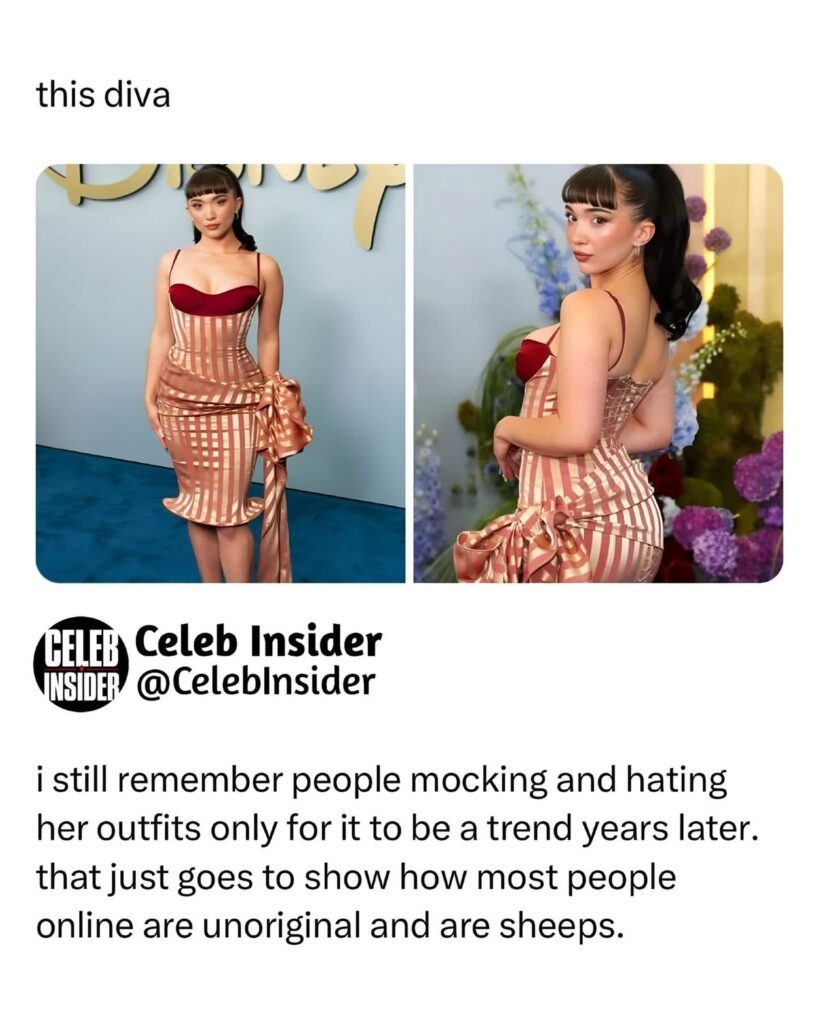
The image features a female celebrity posing in a distinctive vintage-inspired outfit: a fitted corset-style bodice, a structured pencil skirt, thin straps, and a dramatic bow detail around the waist. The design has a highly stylized, retro appearance that immediately stands out from conventional red-carpet fashion.
At the top, the image simply says:
“this diva”
But the real message appears underneath the photographs:
“I still remember people mocking and hating her outfits only for it to be a trend years later.”
The post then makes a broader argument about online fashion culture, suggesting that many people criticize unusual styles until those same styles become popular.
When “weird” becomes fashionable
Fashion trends rarely appear overnight.
Many styles that eventually become mainstream begin with celebrities, designers, musicians, or other public figures experimenting with looks that aren’t immediately accepted by everyone.
The person wearing the outfit may receive comments calling the look strange, excessive, outdated, or impractical.
Then something changes.
A designer collection popularizes a similar silhouette.
A social-media trend picks it up.
Other celebrities begin wearing comparable outfits.
Influencers recreate the aesthetic.
Suddenly, the same style that once attracted criticism becomes fashionable.
That’s what makes the message of this image so interesting.
It isn’t necessarily claiming that one particular celebrity invented every trend. Instead, it highlights a familiar pattern in internet culture: people can reject an aesthetic before they understand where fashion is heading.
Why unconventional celebrity fashion gets criticized
Celebrities live under an unusual level of visual scrutiny.
When an actress or singer appears on a red carpet, thousands of people can immediately comment on her clothing.
The outfit may be judged before anyone considers the creative idea behind it.
Is the silhouette flattering?
Is it too revealing?
Is it too old-fashioned?
Does it look expensive?
Is it appropriate for the event?
And, most importantly:
“Would I wear it?”
That final question can sometimes become the problem.
Fashion isn’t necessarily about creating something everyone would wear.
Some of the most memorable celebrity looks are memorable precisely because they are different.
A conventional black dress might receive compliments, but an unusual outfit can become the photograph everyone remembers.
The power of being ahead of the trend
There is an important distinction between being fashionable and following fashion.
Following a trend is relatively easy. Once thousands of people are wearing a particular silhouette, color, or accessory, choosing it doesn’t require much risk.
Being early is different.
When an aesthetic is unfamiliar, the person wearing it has no guarantee that others will appreciate it.
That’s why celebrities who repeatedly experiment with their appearance can eventually become associated with particular fashion movements.
Their style may initially seem unconventional, but once the broader culture catches up, earlier photographs can suddenly look surprisingly modern.
This creates the perfect environment for posts like the one in this image.
The underlying message is essentially:
“You laughed at it then. Now you’re wearing it.”
Social media has made fashion trends move faster
The internet has dramatically changed how fashion spreads.
In the past, trends could take months or even years to travel from designers to mainstream consumers.
Today, a single photograph can reach millions of people within hours.
TikTok, Instagram, Pinterest, and other platforms can turn a niche aesthetic into a global trend incredibly quickly.
This has also created a strange cycle:
Celebrity wears unusual outfit → people criticize it → someone recreates it → influencers adopt it → trend explodes → everyone wants the look.
Once the trend becomes popular, the original criticism can seem almost ridiculous in hindsight.
Are people really “sheep”?
The image uses deliberately harsh language, describing people online as “unoriginal” and “sheep.”
That’s clearly an opinion rather than an established fact.
People follow trends for many reasons. Some genuinely love a style. Others discover it only after seeing it repeatedly. Some enjoy participating in fashion communities, while others simply like experimenting with popular aesthetics.
Following a trend doesn’t automatically mean someone lacks originality.
At the same time, the criticism does raise an interesting question:
How much of our personal style is actually personal?
Most of us are influenced by what we see around us.
Our clothes, hairstyles, makeup, favorite brands, and even ideas about what looks attractive are shaped partly by culture.
The difference is that fashion-conscious people may consciously reinterpret those influences rather than simply copying them.
Why this particular outfit stands out
The outfit shown in the image has several elements that make it visually distinctive.
The structured bodice creates a corset-like silhouette, while the fitted skirt emphasizes the waist and hips. The vertical pattern adds another visual dimension, and the oversized bow creates a deliberately dramatic finishing detail.
It feels more like a character-driven fashion statement than an ordinary outfit.
That is probably one reason the photograph works so well as social-media content.
It is immediately recognizable.
You don’t need to understand fashion terminology to notice that the outfit is different.
And on platforms such as Pinterest, Instagram, and TikTok, visual distinctiveness is extremely valuable.
The fashion industry has always recycled ideas
One of the most fascinating things about fashion is that very few trends are completely new.
Styles from previous decades repeatedly return in updated forms.
Corsets become fashionable again.
Low-rise silhouettes return.
Vintage tailoring comes back.
Oversized clothing cycles back into popularity.
Retro prints reappear.
Old Hollywood glamour gets reinvented.
What looks revolutionary today may have existed decades earlier.
That’s why a celebrity who wore an unusual vintage-inspired look years ago can suddenly appear incredibly “on trend” when similar designs return.
Fashion doesn’t simply move forward.
It moves in circles.
The real lesson behind the viral post
The most interesting part of this image isn’t necessarily the celebrity or the dress.
It’s the idea of delayed appreciation.
People are often uncomfortable with things they haven’t seen before.
That applies to fashion, music, art, hairstyles, photography, and even technology.
An unconventional idea can be dismissed simply because it isn’t familiar.
Then, when enough people adopt it, the exact same idea can become desirable.
The lesson isn’t that every unusual outfit will eventually become fashionable.
Some trends simply don’t work.
Rather, it’s that being different doesn’t automatically mean being wrong.
Final Thoughts
This viral post captures one of fashion’s oldest contradictions: the person who is ahead of the trend can sometimes look ridiculous until everyone else catches up.
The celebrity featured in the image may have been criticized for an unconventional aesthetic, but the post argues that changing fashion tastes can completely alter how an outfit is perceived.
Yesterday’s “too much” can become tomorrow’s inspiration.
Yesterday’s “weird” can become tomorrow’s Pinterest aesthetic.
And yesterday’s fashion mistake can eventually become someone’s mood board.
Perhaps that’s why fashion is so entertaining in the first place.
Trends change. Opinions change. But the photographs remain—and sometimes they prove that someone was experimenting long before everyone else understood the trend.